Essay 04 / Beyond the machine
Reading an Aircraft Display
An aircraft does not arrive in a gallery with its meaning attached. The exhibition builds a frame around it—and that frame is worth examining.
Notice the first thing you are invited to see
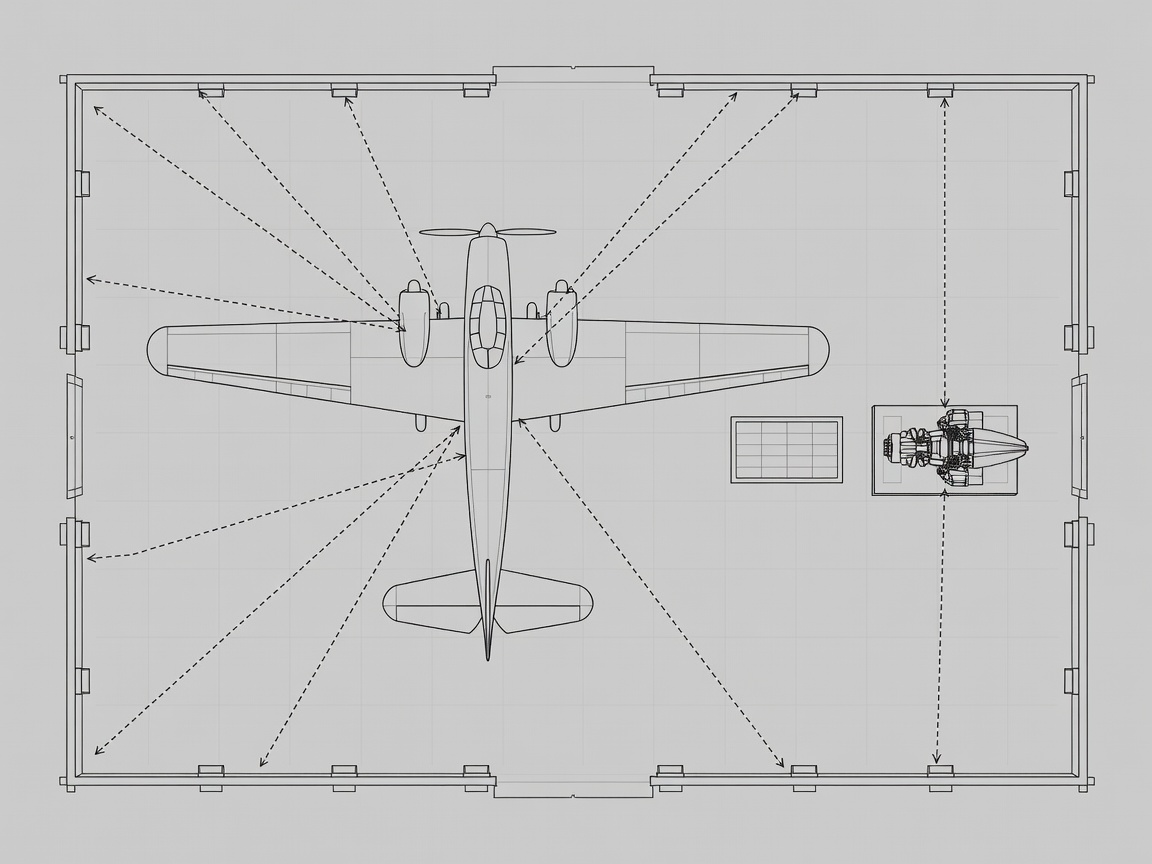
Before reading a label, notice the arrangement. Is the aircraft elevated, crowded among others, placed at eye level or presented against a dramatic backdrop? A suspended machine emphasizes shape and the idea of flight. An accessible ground-level display may reveal inspection panels, undercarriage and the physical scale of maintenance. Neither arrangement is neutral, and neither can show everything equally well.
Architecture also contributes. A surviving airfield hangar connects an aircraft to a working environment, while a purpose-built gallery may offer clearer sightlines and more controlled conditions. At IWM Duxford, the airfield setting and the American Air Museum provide different spatial contexts within a single visit. The setting is evidence in its own right, but it should not be mistaken for proof that every aircraft displayed there served at that location.
Separate the label’s different kinds of claim
A compact label often combines several histories: the aircraft type’s development, the individual exhibit’s service, a pilot’s experience and a later restoration. Read those layers separately. A statement that a type performed a certain role does not establish that this airframe performed it. A production total explains scale, not the particular survival story in front of you.
Look for precise language. “Built as,” “converted to,” “restored to represent” and “replica of” each convey a different relationship to the past. An accession number or collection link helps make the display’s claims traceable. A short label cannot contain an entire research file, but it can acknowledge significant replacements and direct a curious reader toward a fuller account.
Read what is absent
A missing engine may be undergoing treatment, displayed separately or absent from the acquired object. An inaccessible cockpit may reflect fragile surfaces, hazardous materials or the practical need to protect a confined space. An empty bay should prompt a question, not an automatic accusation of incompleteness. Equally, an apparently complete exterior should not encourage assumptions about the systems inside it.
Absence can be social as well as material. Aircraft displays have often found it easier to name pilots and designers than production workers, maintenance crews, radio operators, passengers or people affected on the ground. Ask whether the exhibit connects the machine to those groups. A history confined to speed and range may describe technical capability accurately while explaining very little about the world in which that capability mattered.
Make room for difficult histories
Military aircraft demand interpretation that can hold technical achievement and human consequences together. Admiring an ingenious mechanism does not require ignoring its use. Nor does explaining destruction require pretending that the engineering is historically unimportant. The strongest displays avoid forcing visitors to choose between a machine’s material history and the experiences of people affected by it.
The Smithsonian’s Enola Gay is an especially clear example of why a famous airframe cannot be understood through specifications alone. Its role in the atomic bombing of Hiroshima is central to its historical significance. Responsible reading extends beyond the aircraft to the bombing’s human consequences and the wider wartime context. This is not a reason to disregard the object; it is a reason to refuse a narrow interpretation of it.
Institutional perspective also matters. A national collection may emphasize national service, while a technology museum may emphasize innovation. Neither emphasis necessarily supplies the whole story. Comparing accounts from more than one institution can expose assumptions that are difficult to notice within a single gallery.
Use supporting objects as evidence, not decoration
A logbook, factory photograph, maintenance tool or crew letter can change how an aircraft is understood. Such objects are most useful when their relationship to the airframe is explicit. A period tool may illustrate a general practice without having been used on the displayed aircraft. A photograph may show the type rather than the individual machine. Good interpretation tells visitors which connection is documented and which is illustrative.
The RAF Museum and the National Museum of the United States Air Force provide opportunities to read aircraft within broader collections of equipment, documents and personal material. Their online resources can also help after a visit, when a gallery’s limited space or a crowded label makes detailed comparison difficult. Treat a museum visit as the beginning of a research trail rather than its final authority.
Leave with better questions
A useful final exercise is to write down one strong claim, one unresolved question and one missing perspective. The strong claim should be tied to evidence. The unresolved question might concern a replacement wing or an unexplained marking. The missing perspective might be the maintenance organization, a passenger experience or the community beneath a flight path.
Respect the institution’s boundaries while pursuing those questions. Do not touch, enter or reach into an exhibit without permission, and check current photography and access rules. Staff may not be able to answer specialist questions immediately. A concise note that identifies the aircraft, the label and the source of your uncertainty is more productive than a demand for certainty that the surviving record cannot support.