Essay 02 / What each era leaves behind
Collections Across Aviation Eras
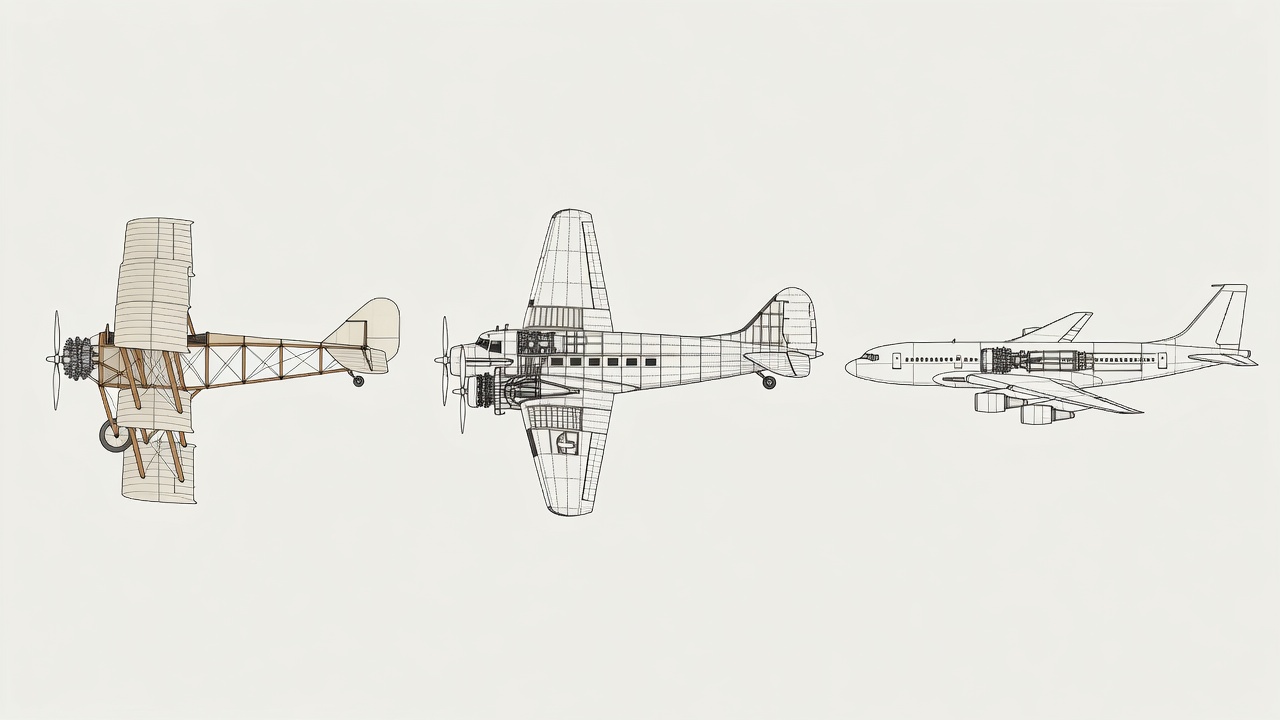
A row of aircraft can look like a simple march from fragile beginnings to sophisticated machines. The surviving evidence tells a less orderly story.
There is no neutral sample of the past
Aircraft reach museums through selection, chance and practical limits. Some were saved because they set records; others survived as training aids, gate guardians, abandoned wrecks or obsolete working machines. Large aircraft need large buildings. Fabric and wood require particular care. A type built in enormous numbers may survive in surprisingly few examples, while a unique experimental aircraft may have been preserved early because its significance was already recognized.
Consequently, a collection is not a statistical sample of everything that flew. It is evidence of aviation history and of collecting history. Before comparing eras, ask what the museum set out to preserve. A military institution, a science museum and a regional transport collection will make different choices. Those choices need not be faults, but they should shape the conclusions a visitor draws.
Early flight: exposed structure, hidden substitutions
Early aircraft invite close looking because their structural logic is often visible. Bracing, ribs, control cables and the relationship between pilot and machinery can be easier to follow than in a later enclosed airframe. Yet an apparently transparent structure does not reveal the age of every piece. Fabric coverings, adhesives, finishes and timber components may have undergone treatment or replacement. Visual simplicity is not proof of untouched survival.
The Science Museum in London and the Musée de l’Air et de l’Espace at Le Bourget provide important contexts for the experimental and pioneering periods. Their objects should be read through their individual catalogues, not through the assumption that every early-looking machine is an original. A replica can explain a design exceptionally well while offering little surviving material from the period it represents.
Mass production: the individual inside the type
Wartime aircraft are frequently presented through performance figures and operational roles. Their material evidence also speaks about standardization, labor, supply chains and repair. A removable panel or interchangeable assembly can reveal an industrial approach as surely as a wing profile reveals an aerodynamic one. The aircraft was not only designed to fly; it was designed to be produced, serviced and returned to use.
IWM Duxford, the RAF Museum and the National Museum of the United States Air Force offer substantial contexts for military aviation. Their collections should not be collapsed into a single story, however. National perspectives, available objects and institutional missions differ. A surviving bomber can support discussion of engineering and crew experience while also requiring an account of the destruction that its operational role enabled.
Service alterations are particularly important in this era. Equipment changed, damage was repaired and machines were adapted to new tasks. Seeking one ideal factory appearance can obscure those lives. An aircraft preserved in a later training configuration may document a real and consequential chapter rather than an unfortunate departure from a supposedly definitive combat form.
Civil aviation: a system larger than the airframe
Passenger and utility aircraft ask a different set of questions. Cabin layouts, cargo doors, insulation, navigation equipment and maintenance access relate to routes, labor and economics. The de Havilland Comet, Boeing 707 and Douglas DC-3 belong to different technological and commercial contexts; none can explain an airline network by itself. The machinery needs to be connected to airports, regulation, scheduling and the experiences of people who could—or could not—afford to travel.
The Canada Aviation and Space Museum in Ottawa is a useful starting point for thinking about aviation within a country’s geography. The Deutsches Museum offers a broader technological setting in which aircraft can be considered alongside other engineering systems. In both cases, the fruitful question is not simply “Which famous machines are here?” but “What relationships does this collection make visible?”
The jet age: visible shells, concealed complexity
Later aircraft can hide much of their significant technology behind smooth skins. A visitor may see the airframe but not the control logic, navigation systems, engine internals or ground infrastructure that made it effective. Removed equipment and inert displays complicate the picture further. An apparently complete aircraft may be physically impressive while lacking systems essential to its former operation.
The Smithsonian’s Bell X-1 and the Concorde displayed at the National Museum of Flight in Scotland illustrate two very different contexts for high-speed flight: research and scheduled passenger transport. Their comparison should begin with purpose, not a contest of maximum speeds. Experimental achievement and a repeatable commercial service demanded different combinations of institutions, resources and acceptable risk.
Across all these eras, resist treating the newest aircraft as the inevitable destination of the oldest. Designs answered particular needs under particular constraints. A convincing collection makes those circumstances legible and acknowledges what it cannot show. The result is a richer history than a sequence of ever-faster silhouettes.